Join the list
Como — early access for veterinary practices

Your clients are filming the symptoms. Como measures them.

Between visits, clients run a guided exam at home — posture, gait, facial close-up — and Como returns a clinical report built on published thresholds, ready for your workup.

  • ✓A structured report with you before the visit
  • ✓Every measurement read against published thresholds
  • ✓What the footage can’t support is voided — never estimated

Places are onboarded in small cohorts. Joining the list takes two minutes.

Join the early-access list

Tell us about your practice. Your details are used only for this programme.

Something went wrong sending that — please check the fields and try again, or email us at admin@comoai.app.

Places are onboarded in small cohorts, so there may be a short wait.

✓

You’re on the list.

We’ll contact you at when your cohort opens — we’ll bring the guided exam and the report format to you at onboarding. Nothing else is needed from you now.

◆Method paper published — Figshare DOI ◆Live on the App Store ◆Screening & monitoring — never a diagnosis
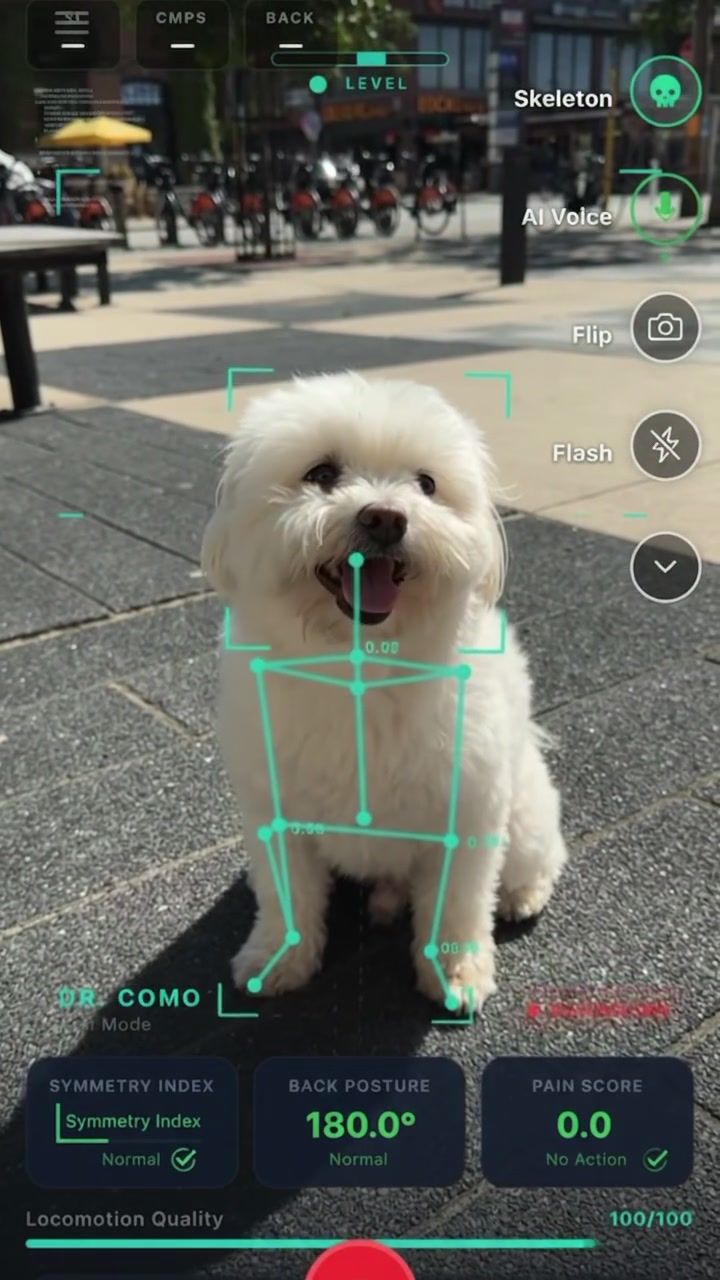
Como app live analysis — skeleton tracked on a dog, with symmetry index, back posture and pain score
Live analysis — the skeleton tracked on the dog, as it runs in the app.
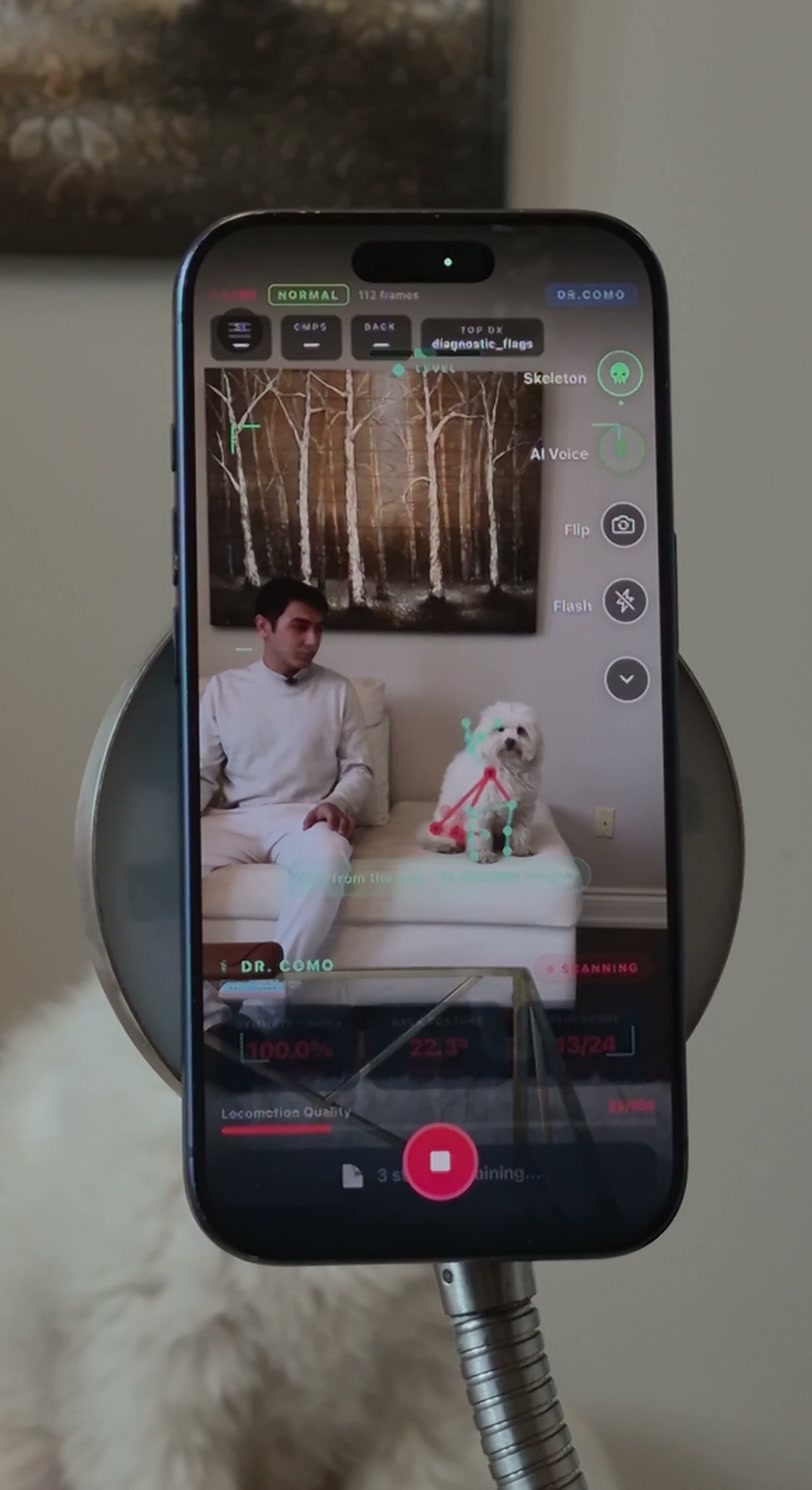
A client running a Dr. Como scan at home, phone on a stand
A scan, as the client runs it — the cards settle once the skeleton resolves.
Symmetry index vs Keegan (2004) Pain on CMPS-SF (Reid 2007) Differentials in SNOMED-CT Voided, never estimated
Approach

Measured at home. Read against published thresholds.

1

Capture

Between visits, the client records a guided exam at home — posture, gait, and a facial close-up — following the app’s prompts.

2

Measurement

Como measures what the recording shows and reads each measurement against published thresholds — symmetry against Keegan (2004), pain on the CMPS-SF scale (Reid 2007).

3

Limits

Where a recording cannot support a measurement, that measurement is voided in the report. It is not estimated, interpolated, or carried forward.

4

Output

A structured report — scores, joint alerts, differentials ranked against SNOMED-CT, and a recommended workup — sent to the practice before the visit.

5

Your call, always

Findings are prompts for hands-on assessment. A flagged measurement is not a diagnosis, and an unflagged report does not rule out disease.

6

Built for the workup

Every report follows the same structure, so your team reads it the same way every time — scores first, then the measurements behind them.

Como screens and monitors. It does not diagnose, and a report is not a substitute for examination — every report routes the case back to the practice.
What practices receive

Every report follows the same structure.

Symmetry index

Read against published thresholds (Keegan 2004).

In every report

Pain scoring

CMPS-SF pain score (Reid 2007) and grimace score in every report.

In every report

Joint-alert mapping

Findings mapped to the joints they point to.

In every report

Ranked differentials

Differentials ranked against SNOMED-CT.

Coded, not free text

A recommended workup

Palpation, ROM, imaging — a suggested next step in every report.

Suggested, not prescribed

Voided, never estimated

Measurements the data can’t support are voided, never estimated.

Applied to every measurement
An example case

The dog looked sound. The measurement surfaced the case.

“6-year-old, no visible lameness. Symmetry index 41.5% — nearly three times the screening threshold. Early osteoarthritis ranked first. Confirmed on examination.”
Patient6-year-old Pomapoo
PresentationNo visible lameness
FindingSymmetry index 41.5%
ReferenceNearly 3× the screening threshold
Ranked firstEarly osteoarthritis
ConfirmationConfirmed on examination
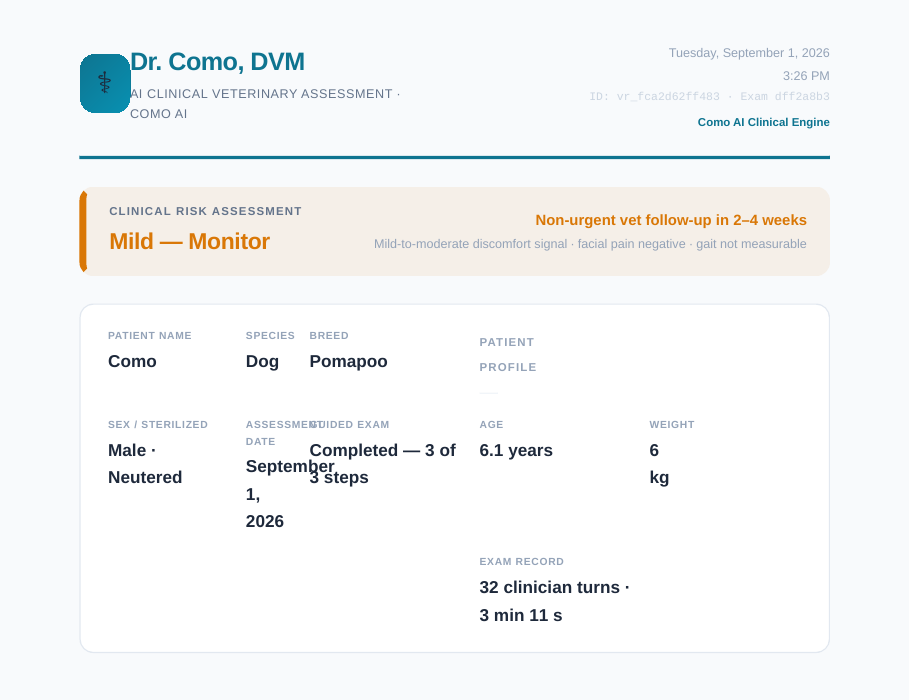
Dr. Como veterinary report, page 1
Dr. Como veterinary report — page 1. A real report, shown as issued.
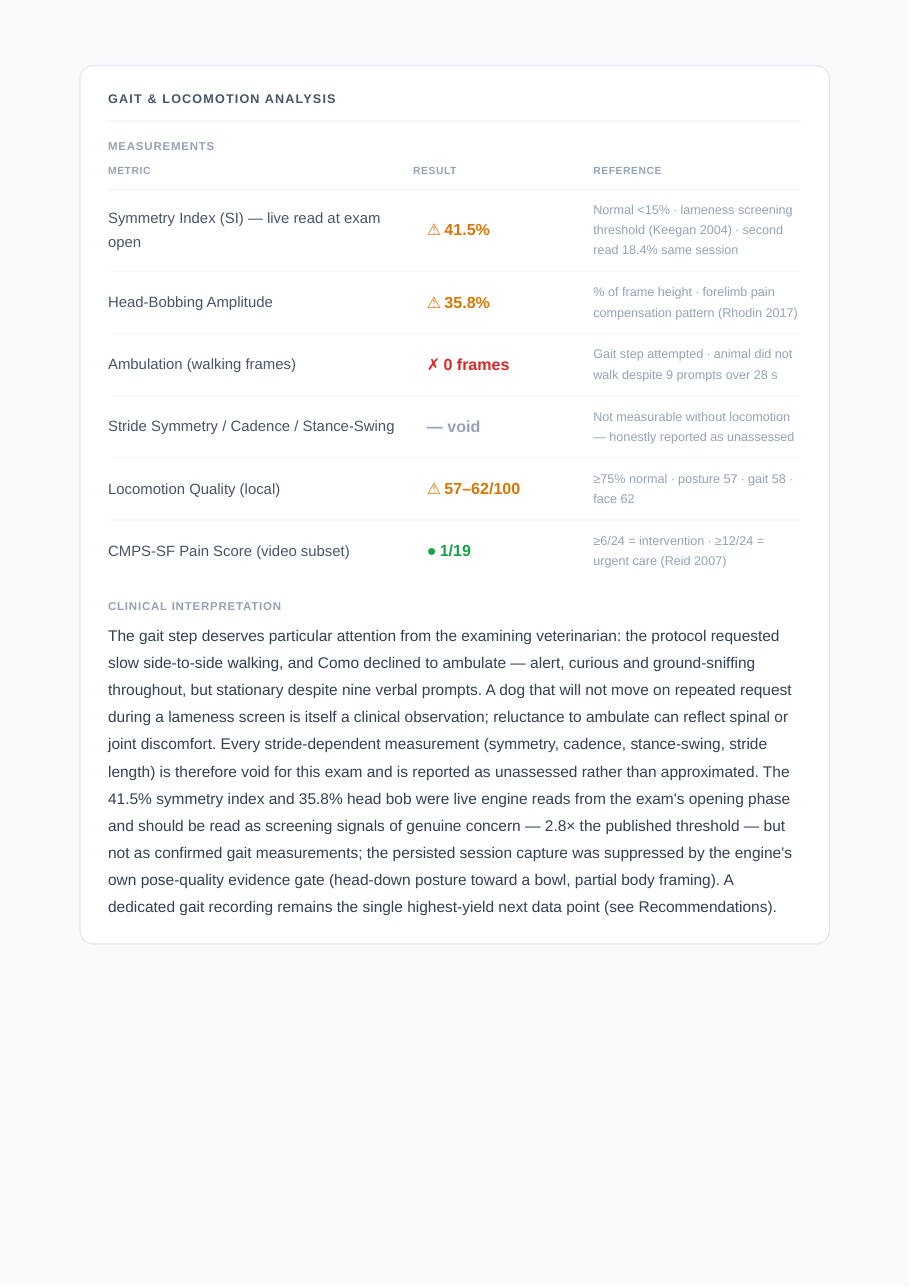
Dr. Como veterinary report, page 3 — gait and locomotion analysis
Page 3 — gait & locomotion analysis. Where the recording couldn’t support a measurement, the row reads void.

One case, recorded as it presented. It is an example of the report’s reasoning, not a performance claim — most reports flag nothing, and a flag is a prompt to examine, not a finding in itself.

How the programme works

Three steps, and the medicine stays yours.

1

Join the early-access list

Tell us about your practice. Places are onboarded in small cohorts.

2

We onboard your practice

We set your practice up and give your clients the guided exam.

3

Reports land with you

Reports arrive with you before the visit, ready for your workup.

Programme progress

3 of 5 milestones complete

Where the programme stands, listed as it stands.

Practice brief

What Como is, in three minutes

For veterinary practices. This is the brief the welcome email points to — one link, nothing to download.

Como is a screening and monitoring tool for dogs and cats. Between visits, your clients run a short, guided exam at home with a phone. Como measures what the camera can support and returns a structured clinical report to your practice — ready for your workup, before the client walks in.

It does not diagnose. Every report routes the case back to the practice for hands-on assessment.

The guided home exam

The client is walked through three captures, with on-screen positioning guidance:

  • Posture — the animal standing naturally, from the side and front
  • Gait — walking toward, away, and across the camera
  • Facial close-up — a short, calm close-up for grimace assessment

What the report contains

  • Symmetry index, read against the published screening threshold (Keegan 2004; flag at ≥15%)
  • Pain score on the CMPS-SF scale (Reid 2007), and a grimace score
  • Joint-alert mapping — which joints the movement data flags, and how strongly
  • Differentials ranked against SNOMED-CT, in order, with the measurements behind each ranking
  • A recommended workup in every report — palpation, range of motion, imaging where indicated

How we handle measurements we can’t support

If the footage cannot support a measurement, that measurement is voided — never estimated, never interpolated. The report shows what was measured, what was flagged, and what was voided and why. A screening tool that invents numbers is worse than one that admits a gap.

Example case

Patient: Como, 6.1-year-old Pomapoo. No visible lameness reported by the owner. Symmetry index: 41.5% — nearly three times the 15% screening threshold. Overall reading: “Mild — Monitor” — CMPS-SF pain score 1/19, grimace 1.19/8. Early-stage osteoarthritis ranked first among the differentials. Confirmed on examination at the practice.

The point of the case: the dog looked sound. The measurement is what surfaced the case.

Questions?

Questions, or a case you’d like us to look at: admin@comoai.app
The exam starts at home. The diagnosis stays with you.

Places are onboarded in small cohorts. Join the list and we’ll bring the guided exam and the report format to your practice.

Join the early-access list